Compute less.
Prove more.
Accelerate science and engineering with mathematically-verified AI.
Verified outputs enable faster iteration without sacrificing rigor across photonics, electronics, thermal, mechanics, and signal domains.
Thanks for joining us at 4YFN26!
We're at Hall 8.0, Stand 8.0D39.2
See our schedule and booth demonstrations
→Making AI Trustworthy for Science
Axiomatic AI was founded on the simple but powerful belief that the
scientific method—our most trusted engine for
discovery—deserves an AI counterpart grounded in the same
principles of logic and evidence. At a time when hallucinated outputs
undermine trust, we are creating something fundamentally different:
Axiomatic_
Drawing on decades of experience in physics, engineering, and computer science, our founding team launched Axiomatic_AI in 2024 to accelerate human progress by merging deep learning with formal logic and physics-based modeling—empowering researchers and engineers to move faster, smarter, and with mathematical certainty.
Axiomatic_Intelligence
Large-scale AI models are powerful statistical systems. They can describe physics, summarize research, and generate plausible solutions. But in high-stakes engineering workflows, fluency is not enough.
Scientific and engineering progress depends on:
- Explicit assumptions
- Inspectable derivations
- Falsifiable claims
- Verifiable compliance with specifications
When AI systems produce answers without exposing their reasoning structure, they cannot be trusted in infrastructure-scale environments.
Validation & Verification
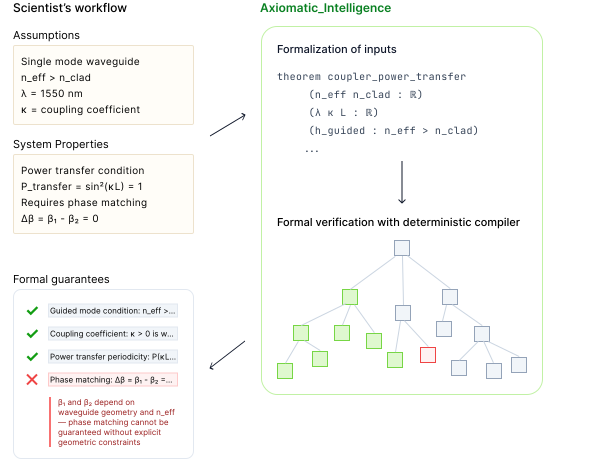
Axiomatic_Intelligence is designed to bring these requirements for scientific work to AI, through formal verification that validates scientific reasoning at a logical and mathematical level.
Results come with a proof—not a confident guess, but a machine-checked, mathematical guarantee.
Lemma: Your AI Co‑Explorer
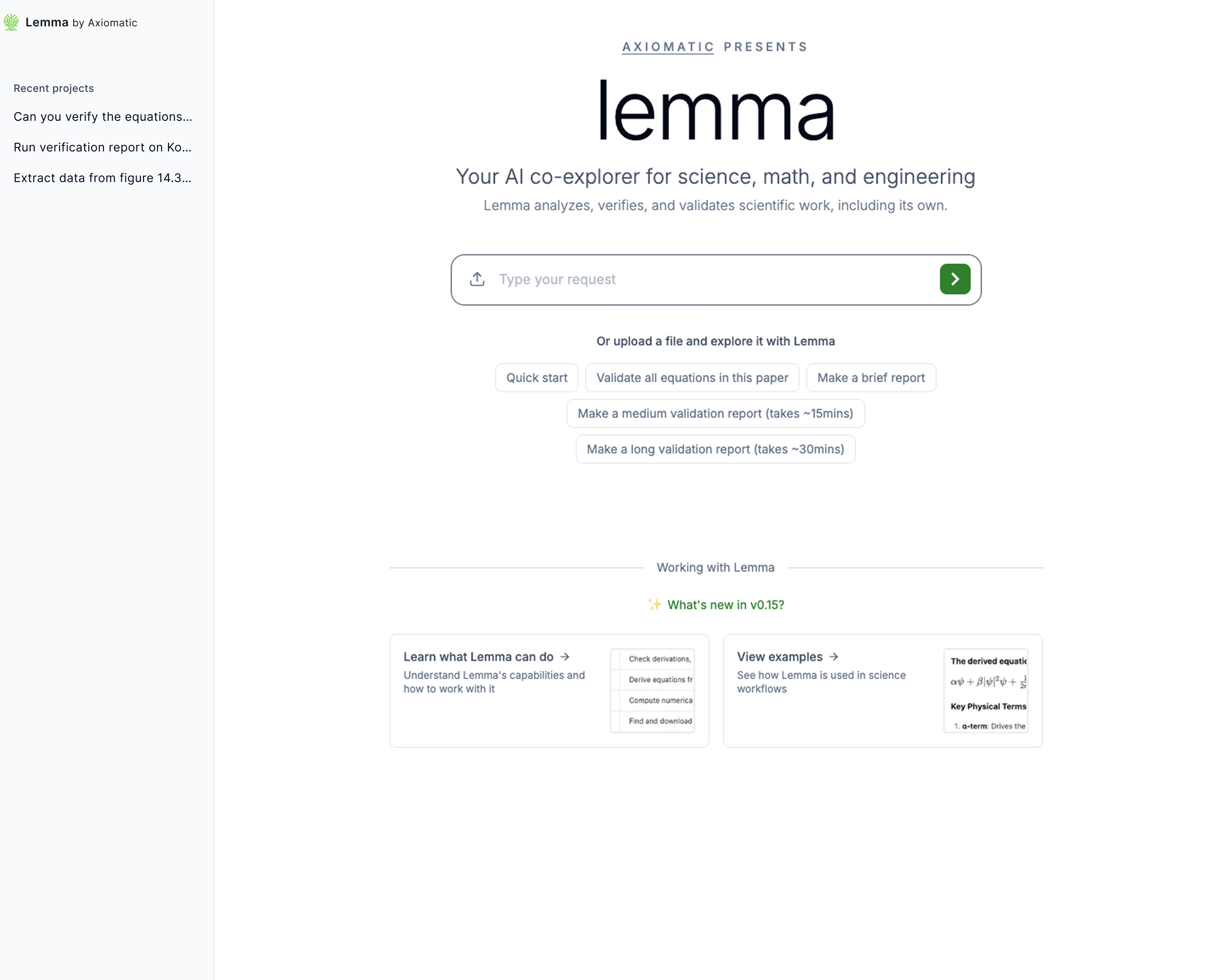
Lemma is your interface to Axiomatic_Intelligence.
Unlike standard AI systems, Lemma directly invokes physics simulators, numerical solvers, optimizers, and symbolic engines to analyze, verify, and rigorously validate scientific work.
From checking derivations and validating papers to identifying errors in patents and building physics-based models from first principles, Lemma is a research partner that doesn't just suggest answers—it proves them.
Unlocking Innovation
The scientific tools that power Axiomatic_Intelligence combine high-fidelity multi-physics simulations with optimization, machine learning, and uncertainty analysis to support robust, scalable, and well-informed design decisions.
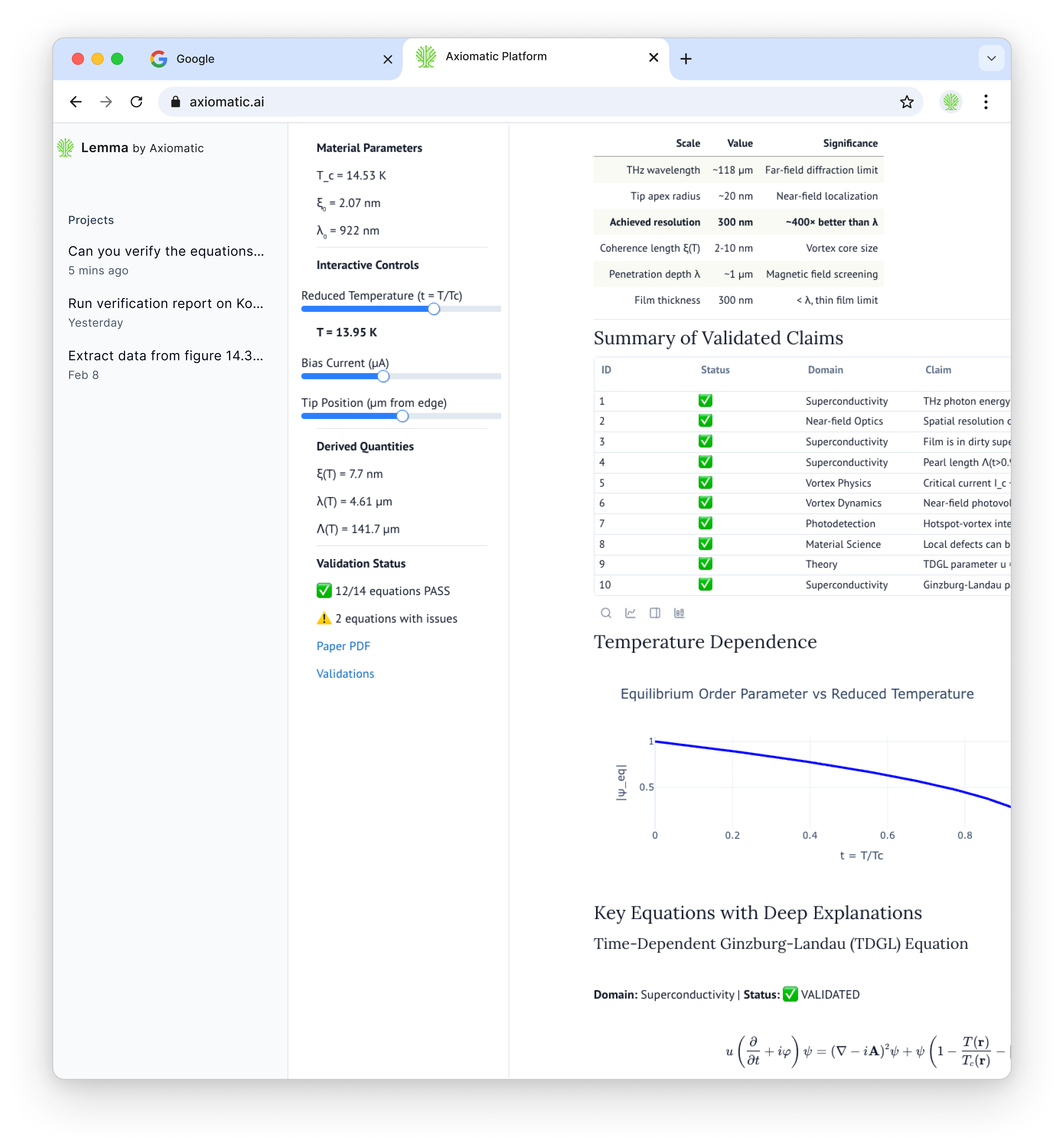
The following notebooks were generated in Lemma, using Axiomatic_Intelligence, and demonstrate some of ways you can use Lemma: for validation, to analyze papers, to use scientific tools, and to learn about new topics.
Click one of the notebooks below to explore Lemma's interactive outputs.
Quantum Quench Heisenberg
"Simulate a quantum quench in the Heisenberg XXZ spin chain starting from the Néel state. Show magnetization, entanglement entropy, correlation functions, and the light cone."
Antenna-Integrated Graphene pn-Junction THz Detector
"Run the optimizer scientific tool on the Castilla et al. 2019 PTE THz detector paper."
Quantum Geometry: Beyond Band Structure
"Explain the basics of quantum geometry in solid-state physics."
Fusion Burn Control Verification Report
"Write a report on the proof of stability of the fusion reactor controller design proposed in the attached paper. Prove it in lean4. Make interactive plots on the stability performance of the new design versus the classical design."
Autonomous Parallel Parking
"Solve body-aware autonomous parallel parking with superellipse obstacle avoidance using optimal control."
Minimum-Time X/2 Gate Design
"Given a fidelity target and leakage budget, find the shortest possible X/2 gate time for a 4-level transmon (Werninghaus et al., npj Quantum Information, 2021)."
Backed by leading investors